

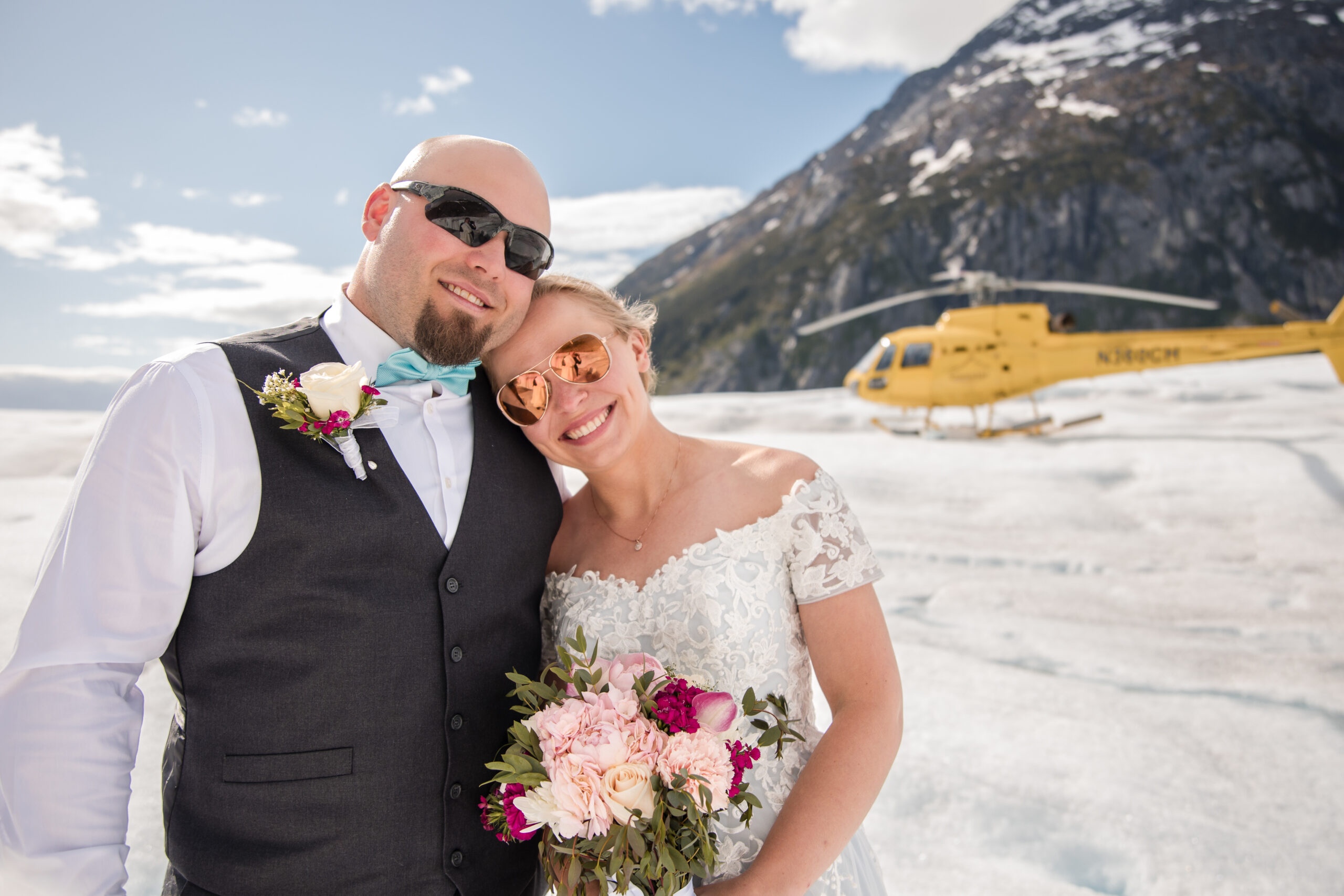
Okay, so you want to elope in Alaska. Clearly you’re already making good choices.
But let me guess: you started searching “how to elope in Alaska,” and now you’ve got fifteen tabs open, three different “ultimate guides,” and somehow you’re more confused than when you started. Don’t worry, you’re not the problem. Alaska is big, very wild, and honestly, some of the info out there is stuck in the past.
Here’s the thing: eloping in Alaska doesn’t have to be complicated, especially if you have the right information in the right order. In my opinion, that looks like this: clear priorities, local vendors who actually know this place, a realistic budget, flights, a marriage license, and a plan that leaves room for the good stuff to happen.
I’m a local Alaska elopement photographer who actually freaking cares about more than just your photos. Yes, the images matter, but you being able to show up, breathe, and actually feel your day in real time matters more.
So this is your no-nonsense, no-gatekeeping guide to eloping in Alaska in 2026. We’ll walk through the legal steps, the best regions, when to come, what this really costs, and what most people get wrong, so you can stop searching and spend more time doing what you love together.
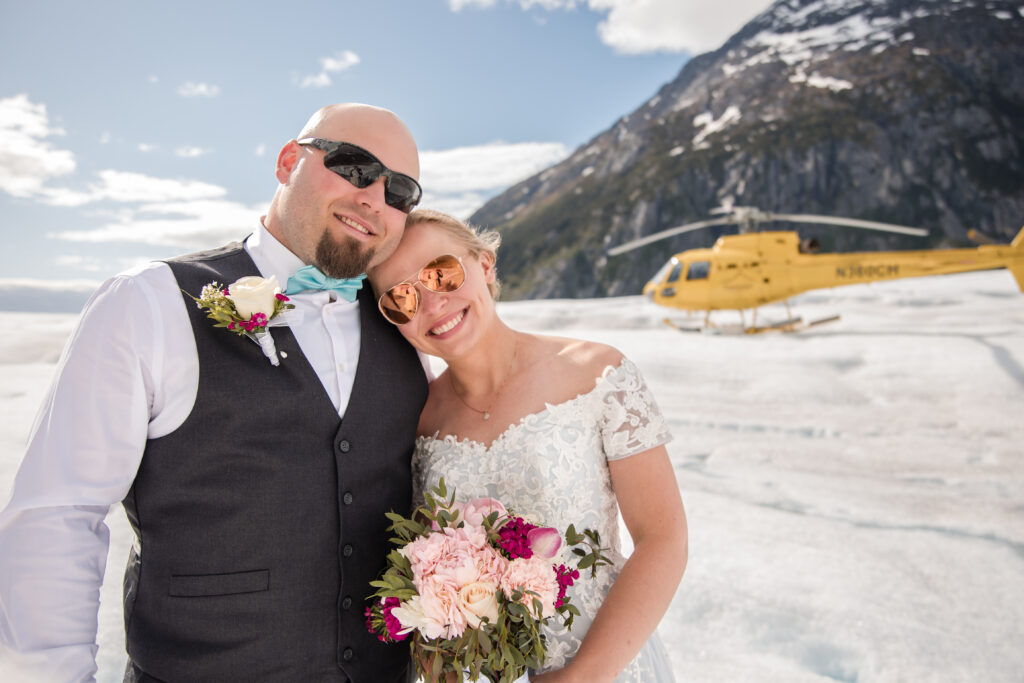
In this guide:
- What eloping in Alaska actually looks like
- Choose your landscape and your priorities first
- The main regions to consider first
- When to elope in Alaska
- Alaska marriage license basics
- What it costs to elope in Alaska
- Common mistakes couples make
What eloping in Alaska actually looks like
Eloping in Alaska is this weirdly perfect combo of “middle of nowhere” and “surprisingly easy to get to.” If you’re coming from the lower 48, you can fly here without a passport, land in a place like Anchorage or Juneau, and get to mountains, glaciers, beaches, or rainforest without having to dedicate your whole trip to driving. Alaska guides consistently frame the state as one of the easiest ways to get huge scenery without leaving the U.S., and that matches the lived reality of planning here.
Most couples picture Alaska as one giant wall of mountains and ice, but that’s part of what makes planning here tricky: it’s not one thing. Southcentral gives you easy access and variety, Seward brings water and wildlife into the mix, Denali is huge and iconic, Matanuska gives you glacier access without a helicopter, and Southeast puts rainforest, ocean, and glacier energy all into one smaller footprint. Those are very different experiences, which is why choosing a region first makes the rest of the planning process so much easier.
The best part of eloping here is that you can be very alone in the wild and still have access to good food, a warm place to sleep, and people who know what they’re doing. That combination is what makes Alaska so good for elopements. It doesn’t have to be a survival exercise to feel adventurous.
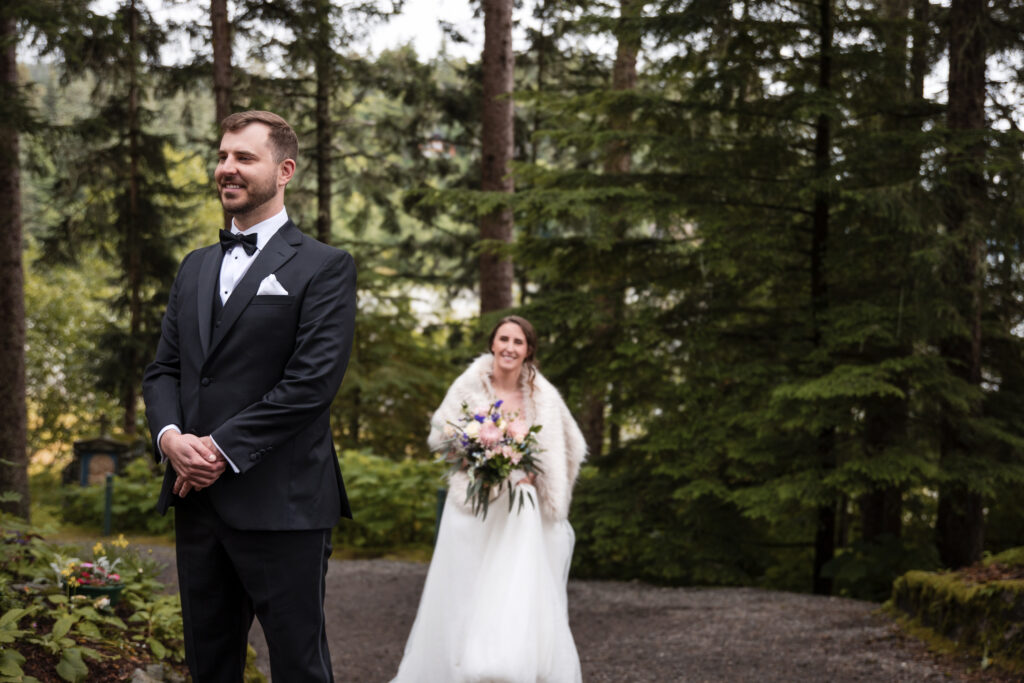
Choose your landscape and your priorities first
Before rattling off location ideas, there are always two questions to start with:
- What actually matters most to you about the experience?
- What kind of landscape do you want to spend your day in?
And if you are thinking, “Whoa, slow down. You should probably buy me dinner first before we start talking about values and stuff…” you are not wrong. It can feel like a lot at first, but these questions are what make sure your day actually feels like you, not just like a pretty picture someone else posted.
Anyone can scroll Instagram, see a pretty glacier, and say “yes, that one.” But different parts of Alaska quietly cater to different values. Do you want a full‑day hike where you earn every view? Something more “wow with less effort” so you can slow down and enjoy the day? Maximum privacy? Easy access for family? A little bit of everything?
Alaska has almost everything
Alpine ridges, calm lakes, rainforest, wide‑open tundra, glaciers, ocean, islands—basically everything except the desert. Once you know the kind of place you want to be in and what you want the day to feel like, picking the right region gets a lot easier. And do not hesitate to circle more than one; this is the dreaming stage. This is where you think as big as you want and let a local guide help figure out how to make it happen.
Here is a very simplified example: if you want to hike all day and feel like you are on another planet, Hatcher Pass might be your place. If you want water, boats, and wildlife, Seward or Southeast will probably light you up more. If you care deeply about privacy, the plan is going to look very different than if you want lots of activity and do not mind crossing paths with other people. Denali sounds amazing on paper, but if you are dreaming of total solitude, some of the lesser‑known regions or private‑access spots will usually serve you better.
That landscape‑and‑priorities combo is the best place to start, but most people still want to see what that could look like, not just hold it in their heads. So if your brain is already trying to storyboard your whole day, you are not alone. With that in mind, here are some of the main regions couples usually start with, plus one that tends to surprise people (hi, Juneau) because it quietly pulls together mountains, ocean, rainforest, and glacier into one place.
The main regions to consider first
One of the quickest ways to get overwhelmed by Alaska is to treat the whole state like one big blob of mountains and glaciers. It is not. For elopements, most couples end up choosing between a handful of regions that all have very different vibes, price points, and logistics.
Think of this as the pick‑your‑player screen. You do not need to know your exact ceremony spot yet. You just need to know what kind of Alaska feels most like you two.
Chugach / Girdwood / Knik
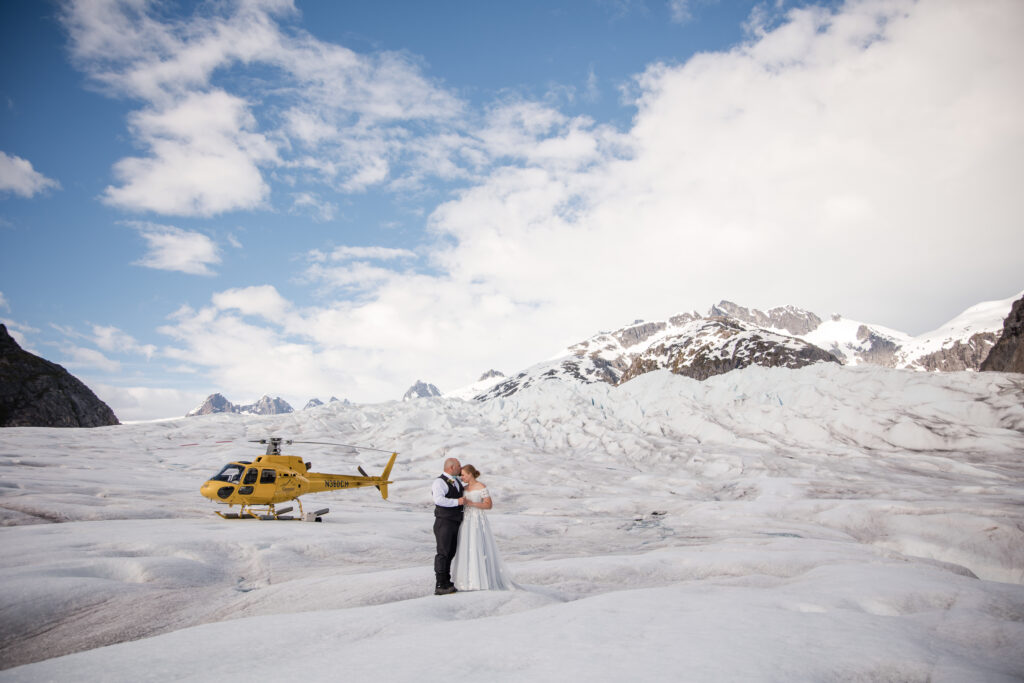
If you want wild Alaska without spending half your trip in the car, this is usually where I start. You can fly into Anchorage, grab your bags, and be in the mountains or at the edge of a glacier fast, which makes this area one of the easiest entry points for couples who want dramatic scenery with less logistical friction. Chugach National Forest and nearby glacier access are commonly recommended because they give couples a lot of variety in one region.
This region is great if you want to stack a lot into one day: maybe a helicopter in the morning, mountain views later, then a cozy dinner somewhere warm at the end of the night. It is also a good fit if you are bringing a few people and do not want everybody spending all day in transit.
Hatcher Pass
Hatcher Pass is about 90 minutes from Anchorage and feels like you accidentally landed in some secret alpine world. It is open tundra, sweeping ridgelines, old mining history, and a lot of drama without needing a flight or a huge hike to get it. Hatcher Pass also tends to show up in Alaska elopement planning because small ceremonies on state land are generally simpler from a permit standpoint than more regulated national park spaces.
This is a great option for couples who want mountains without a helicopter and who like the idea of a little effort earning them a lot of payoff. It can be soft and green in summer, then turn gold and rusty red in early fall, which makes it one of the most flexible regions seasonally too.
Seward / Kenai Fjords
If you want water to feel like part of the day instead of just the backdrop, Seward is hard to beat. This area brings together ocean, mountains, wildlife, and glaciers in a way that feels very Alaska without feeling inaccessible. Kenai Fjords and Resurrection Bay are often recommended because you can combine a land‑based day with boats, wildlife viewing, and coastal scenery that is completely different from interior Alaska.
This region is especially good for couples who love the idea of whales, sea otters, moody mornings, and ceremony options that feel a little softer and more coastal than the “stand on top of a mountain” version of Alaska. Exit Glacier also gives you a nearby glacier option without needing a full helicopter experience.
Talkeetna / Denali area
When people say they want “Denali,” they do not always mean the national park specifically. A lot of the time they mean the feeling of huge mountain energy, bush planes, glacier flights, and that full‑body “holy shit” moment when the mountain actually decides to come out. Denali National Park ceremonies do require a special use permit and deeper park access can mean buses and more planning, while Talkeetna‑based glacier flightseeing is often easier and more flexible.
This region is great for couples who care about the significance of Denali and want the trip to feel iconic. Talkeetna gives you the quirky town plus flightseeing version, while Healy and the park interior make more sense if being inside the national park itself matters to you.
Matanuska Glacier
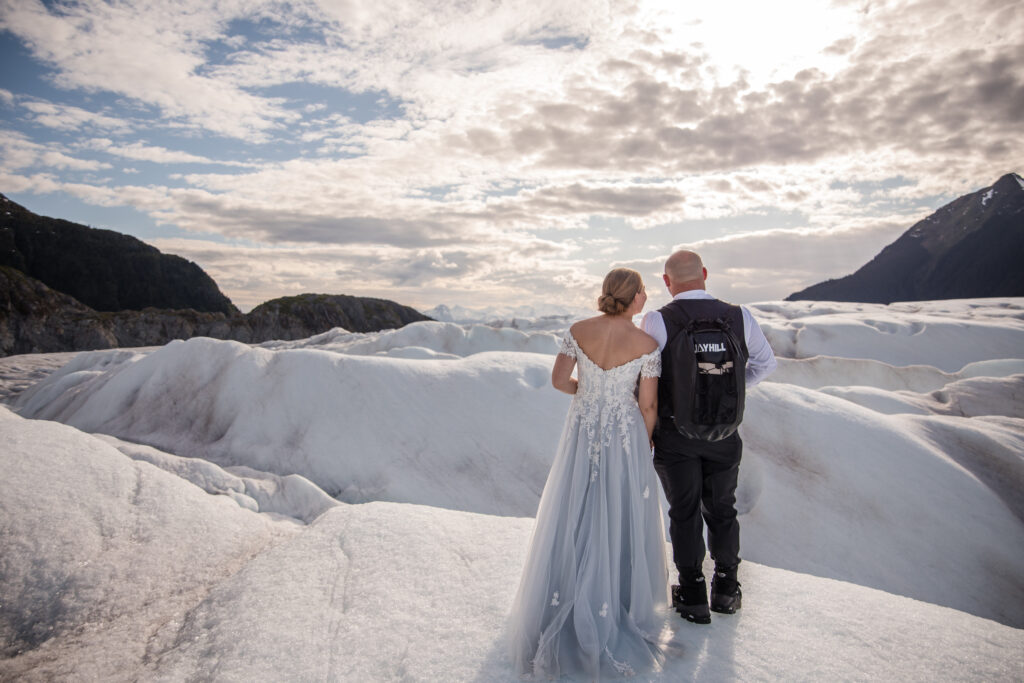
Most stand‑on‑a‑glacier experiences in Alaska involve a helicopter. Matanuska is the exception, which is why it matters. It is one of the most accessible glacier experiences in the state, with private‑land access and elopement options that range from a glacier‑view ceremony to helicopter‑assisted packages depending on how extra you want to get. Recent Matanuska offerings include simpler land‑based access and upgraded helicopter options, which makes it one of the easiest glacier regions to scale up or down by budget.
This is a great option if you want that big‑blue‑ice feeling without a full remote‑flight plan. It is also one of the most practical ways to make a glacier the centerpiece of your day without building your whole trip around it.
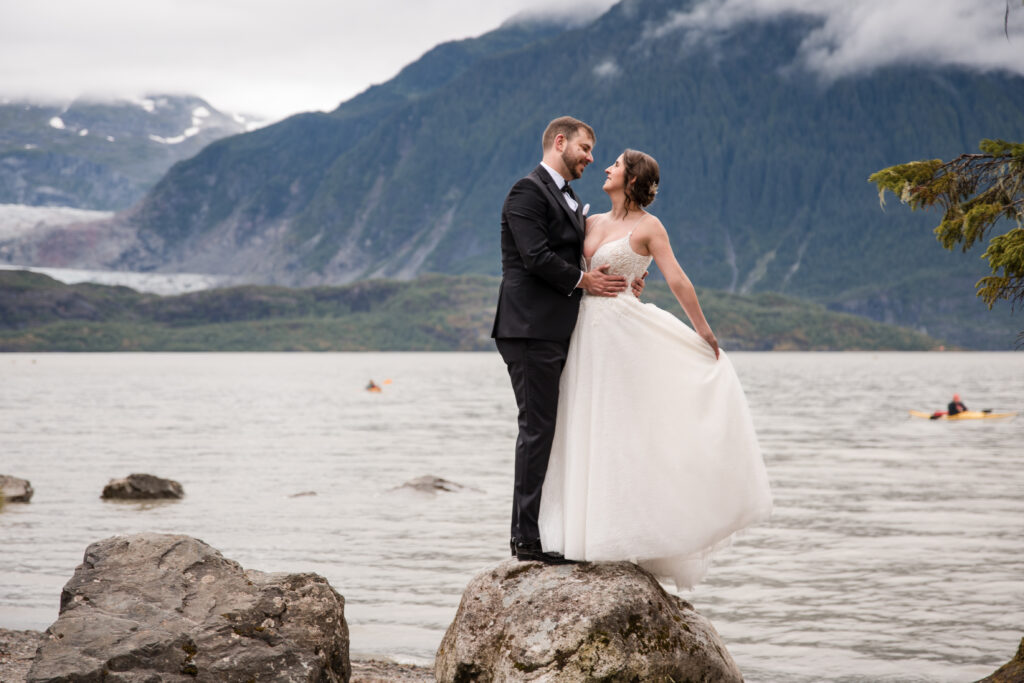
Juneau & Southeast Alaska – the most underrated location
Most Alaska elopement guides barely talk about Southeast and Juneau, which is honestly a miss. I always say Juneau has all the beauty and ruggedness of Alaska without quite as many of the big‑animal stressors people worry about elsewhere. You still get real wilderness, but your elopement does not have to turn into a survival show.
This part of the state gives you mountains, ocean, rainforest, glaciers, wildlife, and a real working town all in one smaller footprint, which makes it feel like everything people want from Alaska without so much time eaten up by driving. Juneau also sits outside Alaska’s road system, which means once you are here, you are here—and that tends to simplify decision‑making in a way people do not expect.
Yes, Juneau is a cruise destination, but that is not the whole story. It is also a jumping‑off point for smaller expedition cruises and luxury yachts, which can absolutely become part of the elopement itself or the adventure after. If you want a place where you can base in one town, reach glacier, forest, alpine, and ocean quickly, and maybe roll straight into a boat‑based Southeast adventure after your ceremony, Juneau is your place.
If you read this whole section and thought, “Honestly, Juneau sounds like it quietly wins,” you are not wrong. That is the hill I am happily willing to die on.
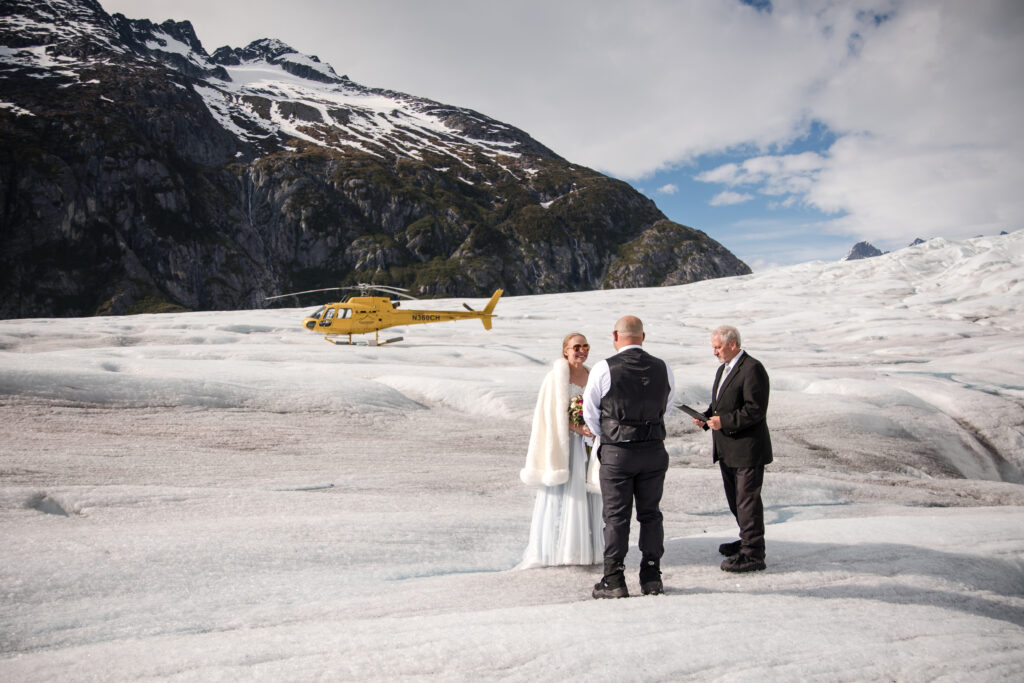
When to elope in Alaska
“Best time to elope in Alaska” is one of those questions that sounds simple and then immediately gets complicated. Summer looks dreamy, fall colors are ridiculous, winter has the northern lights, and suddenly you are trying to plan around twelve different versions of Alaska at once. The broad trend across Alaska planning guides is pretty consistent: summer is the easiest for access, September is a favorite for color and fewer crowds, and winter is incredible if you actually want winter instead of just tolerating it.
A quick but very real note about Alaska weather
Before we get too deep into seasons, we need to talk about weather—because it is the number one question people ask and the one thing I will never pretend to predict.
You can absolutely look at trends and averages, but Alaska is wild. In a single day you might get sun, sideways rain, low clouds, wind, and then the softest golden light you have ever seen… sometimes all in the same hour.
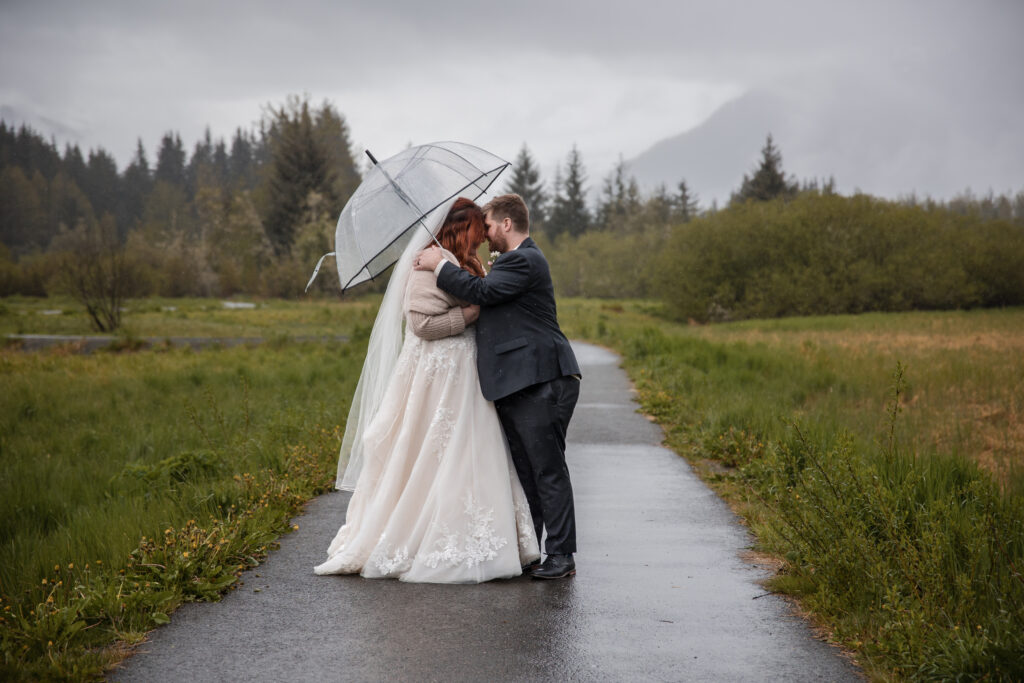
That is not a reason not to come. If anything, it is part of the fun of being here. It is, though, your reminder to build in extra time, pack layers, and bring an adventurous, flexible attitude. If you are the kind of person searching “how to elope in Alaska,” that probably describes you already.
The couples who have the best time here are the ones who expect Alaska to be Alaska—and trust that the unexpected moments make the best memories anyway. I say this all the time: you can get blue skies and sunshine almost anywhere, but Alaska has a really special way of making cloudy days magical. Something about the mountains and trees—the clouds just wrap around them and settle in.
Summer
Summer is the most popular time for Alaska elopements for a reason. You get the longest days, the easiest access, the most open trails, and the widest range of tours and activities running. June through August is consistently treated as peak Alaska season because it makes the greatest number of locations workable in one trip.
If you want long daylight, classic green mountains, wildflowers, boats running, and the ability to combine a lot of things in one trip, this is the easiest season to work with. Summer is especially good if you want the “all the options” version of Alaska.
The trade‑off is that everyone else knows summer is great too. That means more visitors, pricier lodging and rental cars, and the need to book earlier, especially in popular areas. August can also start leaning wetter depending on where you are, especially in coastal parts of the state.
Fall
If you care more about mood and color than maximum sunshine, fall is hard to beat. Mid‑August into September is when a lot of Alaska starts shifting into gold, rust, and red, and mid‑September is often the sweet spot for rich fall color in mountain‑ and tundra‑heavy areas. Fall also tends to come with fewer people, which changes the whole feeling of the day.
This is a really good fit for couples who want Alaska to feel a little quieter and a little moodier. You still get workable daylight, but the light gets softer, the crowds thin out, and the whole state starts looking like it knows exactly what it is doing.
The thing to know is that fall also asks a little more flexibility from you. Rain is common, clouds are common, and higher‑elevation areas can start slipping toward snow quickly by late September or early October. If you can roll with that, it is a fantastic time to be here.
Winter
Winter in Alaska is not the easy, one‑size‑fits‑all version of eloping here, but for the right couple it is ridiculous in the best way. Think snow, low golden light, quiet, maybe hot springs, maybe dog sledding, maybe northern lights if you plan it well and get lucky. Winter planning guides for Alaska consistently position it as a more intentional, experience‑driven season rather than the “do everything” season.
This is usually best for couples who actually want winter and are willing to build the day around what winter gives them instead of fighting it. That can mean shorter daylight windows, more travel flexibility, and a little less variety in activities than summer, but it also means a kind of calm and silence that summer just does not have.
If the northern lights are a real priority, interior Alaska tends to be the better bet, and building in extra time helps because this is one of those things you can encourage but not control.
Shoulder seasons
The in‑between months can be surprisingly good if you are flexible. April into May can feel muddy, thawing, and a little messy in places, but it can also be quieter, moodier, and more affordable. Late September into October can be that weirdly beautiful edge where fall color and first snow start mixing together. These shoulder windows are not for people who want guaranteed perfection, but they can be incredible for people who like Alaska when it feels a little less polished.
If you want more privacy and do not mind mixed conditions, these are worth looking at. You just need to be realistic that some tours may not be fully running yet in spring or may be winding down by late fall.
How to choose your month
If you want long days, full access, and the easiest version of Alaska, start with June or July. When color, mood, and fewer people are your vibe, look at September. If you are dreaming about snow, aurora potential, and a quieter kind of adventure, winter is your season. And if you want something a little less obvious and you are okay with building in some flexibility, shoulder season can be a really good fit.
If you are planning anything near rivers, tidal flats, or shorelines, there is one very Alaska‑specific thing to keep in mind: salmon season. When the salmon are running, it is incredible for wildlife and very cool to witness—but it also means some stretches of shoreline can be lined with dead fish, and that does not smell very magical up close. It is not a dealbreaker, but it is something to factor in if you are picturing barefoot‑on‑the‑beach vows or a picnic right by the water.
Those seasonal trade‑offs show up over and over in Alaska elopement planning for a reason: they are genuinely the big levers couples are choosing between. You do not have to know your exact date yet, but knowing whether you are a “long golden evenings,” “moody fall colors,” or “snow and stars” person will narrow your options in the best way.
Alaska marriage license basics
Let’s talk about the least romantic, most necessary part of eloping in Alaska: the paperwork. The good news is that Alaska’s process is pretty straightforward once you know the order of operations. Both Alaska residents and nonresidents can apply, you do not need a blood test, and the marriage license is only valid for ceremonies performed in Alaska or Alaska state waters.
The main thing to know is that Alaska has a three‑business‑day waiting period, and that countdown starts when the issuing office actually receives your application, not when you start thinking about mailing it. After the license is issued, it stays valid for three months, which gives you a decent planning window but also means you do not want to apply so early that it expires before your trip. Alaska also does not allow proxy marriages, so both of you need to be physically present for the ceremony.
How the process actually works
In plain English, the process usually looks like this:
- Fill out the Alaska marriage license application.
- Send it in with the fee to an Alaska Vital Records Office or an Alaska Court Office.
- Wait out the required three full business days after the office receives it.
- Receive or pick up the license.
- Have your ceremony in Alaska before the license expires.
- Make sure the correct people sign everything afterward so the marriage can be registered properly.
That is the whole legal arc. Nothing about it is especially hard, but it goes a lot more smoothly when it is handled ahead of time instead of squeezed into your travel days. The more you can treat this as pre‑trip admin, the more your actual time in Alaska can feel like an experience instead of a to‑do list. There are only a handful of physical locations across the state where you can pick up a license in person, and spending your limited time here tracking one of those down is almost never how you want to spend a vacation day.
Mailing it in vs. getting it in person
Technically, you can submit the paperwork and deal with the license process in person, but for most couples that is not the best option. You can absolutely mail your application, the waiting period still starts once the office receives it, and you can include extra payment for priority mail with tracking if you need the license returned quickly. The standard application fee is $60, and it becomes $70 when you add priority shipping.
On paper, getting the license in person sounds spontaneous and fun. In reality, it usually means burning a chunk of your trip on office hours, timing, driving, and paperwork. For most couples, mailing everything ahead of time is just easier—or honestly, the only realistic option based on where you are eloping. You do the boring part while you are still at home, and once you get to Alaska you can spend your energy on the actual reason you came.
That said, if you have a very specific timeline or you really want to make the in‑person part of your story, it is still possible. It just takes extra planning, because there may not be a physical office anywhere near where your ceremony is happening.
Who can marry you
This starts to matter a lot once you decide to skip the traditional wedding. In a typical ceremony, someone stands in front of you, reads more or less a script, and that becomes “the official legal part.” But the legal part is not the same thing as the promises you make to each other, and it does not have to be a big production unless you want it to be.
If you want to keep things especially simple and intimate, there is the option for your photographer to also be your officiant. As a commissioner of marriage in Alaska, I can legally marry you and sign your paperwork, which means you do not need to hire a separate officiant or add one more person to the day. For couples who want as few moving parts as possible, or who care more about the feel of the whole day than a formal, scripted “legal moment,” this can be a really good fit.
It also changes the feel of the ceremony. If I am the one legally marrying you, there is not another person physically standing between you two in the way that a more traditional setup often looks. The words for the legal part will be simpler and shorter, and that leaves more space for you to share your own promises freely, in your own way. The trade‑off is that the legal portion of your ceremony may not look as traditional as what you have seen at big weddings. It also might not be documented in quite the same way as when I am only photographing and someone else is officiating. So it really comes down to what matters more to you and what you want that moment to feel like.
Friends and family can be part of the legal side too
If you have always pictured a friend, family member, or dedicated officiant leading your ceremony, that is a beautiful option, and there are many ways to make that a reality. Some couples want a loved one speaking over them; some want the simplest legal setup possible. Neither is better, they just create different energy.
One of the nice things about a small Alaska elopement is that your people can be part of more than just the emotional side of the day. They can also be part of the legal side.
Your witnesses do not have to be strangers unless you want them to be. Your best friends, siblings, or parents can stand there with you, watch you get married, and sign the license afterward. That can make the paperwork feel a lot more meaningful, because the people signing are not random folks who happened to be nearby. They are the people who know your story and got to witness this exact moment.
Alaska requires the parties to be present with at least one witness and an officiant, and the officiant cannot also be the witness. If you are eloping completely alone, that can still be solved. It just takes a little planning so the right people are in place to make everything official without making the day feel crowded or performative.
A couple extra details people forget
There are a few details that are easy to miss when you are in full “planning the fun part” mode:
- If either of you was divorced recently, you may need to provide a copy of the divorce decree if it was finalized less than a certain number of days before applying.
- Once the license is issued, there are no refunds or extensions if it expires.
- If you later need official proof that the marriage was registered with the state—for name changes, insurance, or other paperwork—you will usually need to order an official marriage certificate for an additional fee after you return the signed license.
None of this should make or break anything. It is just the kind of information that is easier to know now than two weeks before your flight.
Legal checklist
You can include this right in the post, or you could show a shorter version and turn the full checklist into a little freebie (“Get the Alaska legal checklist”) for your email list. Both are valid options; if you gate it, just make sure the blog still gives enough information that people feel helped even if they do not opt in.
Here’s a solid, blog‑ready version:
- Confirm you are both eligible to apply.
- Fill out the Alaska marriage license application.
- Mail the application with payment to an Alaska Vital Records Office or Alaska Court Office.
- Plan for the three full business day waiting period starting when the office receives the application.
- Add priority mail if you want tracking and faster mailing; the total becomes $70 instead of $60.
- Double‑check that your ceremony date falls within the three‑month license validity window.
- Decide who is marrying you: commissioner, friend/family officiant, or another legally able officiant.
- Decide who your witness or witnesses will be, and make sure the officiant is not also serving as the witness.
- Bring the license to the ceremony and make sure it gets signed correctly afterward.
- Return whatever needs to be returned so the marriage is registered properly.
- Order the official marriage certificate later if you need it for name changes, insurance, or other paperwork.
My honest recommendation? Do the legal admin early, mail it in, and keep your Alaska trip for the good stuff. The less time you spend trying to track down paperwork while you are here, the more space you will have to actually enjoy getting married.
What it really costs to elope in Alaska
Once couples decide “Alaska,” the very next question is usually, “Okay, but what does this actually cost?” Elopements are usually more flexible and intentional than big weddings, but they are not automatically the “cheap” option. You are still planning a trip, hiring professionals, and building a day that feels like you, just without the 150 extra chairs and a ballroom you do not care about.
Most Alaska guides put total elopement costs in a wide range, because it depends so much on how travel‑heavy and adventure‑heavy your plans are. Simple Alaska elopements with a few vendors and no big tours can land toward the lower end, while multi‑day or helicopter‑heavy adventures land higher. Some Alaska‑specific guides estimate all‑in ranges anywhere from the high four figures up into the 20–30k bracket once you factor in flights, lodging, photography, tours, and time on the ground.
Instead of locking you into exact numbers, it is more helpful to know which pieces move the needle the most.
The biggest pieces of an Alaska elopement budget
For most couples, the main cost categories look something like this:
- Travel in and out of Alaska
Round‑trip flights from the lower 48 to Alaska often land roughly between a few hundred dollars to around a thousand per person depending on season and booking window. That adds up quickly if you are flying more than just the two of you, and goes higher when you add small planes or ferries on top. - Lodging and time on the ground
Most couples stay about 5–7 days. Mid‑range to nicer lodging in popular areas can easily land in the low‑to‑mid hundreds per night, with wilderness lodges or all‑inclusive stays running higher. Juneau‑based and Southeast stays can sometimes be more efficient because you are not paying to hop between multiple towns. - Photography and planning help
Alaska elopement photographers often sit in the multiple‑thousand‑dollar range for full‑day or multi‑day coverage depending on hours, locations, and travel. You are paying for both the images and the expertise of someone who actually knows how to build a day that works here—permits, backup plans, and all. - Tours, helicopters, and activities
This is where some couples really choose to invest. Helicopter or bush‑plane experiences in Alaska often run into four figures, and guided tours or boat trips can range from a few hundred dollars to much more depending on what you choose. A simple land‑based day will look very different cost‑wise from a “we are flying to a glacier and then hopping on a boat” day. - Attire, florals, hair and makeup, and details
Some couples keep this very simple; others still want a full gown, suit, bouquet, and professional hair and makeup. Alaska guides often place these in the low‑to‑mid thousands when you add them all up, but you can scale them up or down to match your priorities. - Legal fees and permits
Alaska’s marriage license fee is one of the smallest line items (60 dollars standard, 70 with priority mail), but special‑use permits for parks or public lands can add a bit more depending on your exact location.
You do not have to max out every category. Most couples pick one or two areas to really splurge on and keep the others simpler.
One example: a Juneau‑based trip vs. a higher‑end adventure
To make this feel less abstract, here is a rough sketch of two different ways couples might invest.
- A Juneau‑based, mid‑range elopement (roughly 15 – 20k all‑in)
Think 5–7 days in Juneau, round‑trip flights, mid‑range lodging, local transportation, photography and planning, simple florals, a land‑based or short boat tour, and your legal fees. You base in one town, reach glacier, forest, alpine, and ocean quickly, and keep costs in check by not hopping all over the state. - A multi‑location, helicopter‑heavy adventure (often 25k+)
Think flights into Anchorage, then stacking regions: helicopter glacier experience, inland travel to places like Hatcher Pass or Matanuska, maybe a Kenai Fjords day, higher‑end lodging, and a full team of vendors. The day feels huge and cinematic, and the budget reflects the number of flights, tours, and travel days involved.
Neither option is “better.” One keeps things contained and efficient, with Juneau doing a lot of the heavy lifting; the other spreads the adventure out across multiple regions. Which one makes sense depends on your priorities, not what you are “supposed” to spend.
One example: big ships, small ships, and private boats
One way couples fold Alaska into their elopement or honeymoon is by using cruises or boats as part of the experience.
At the more budget‑friendly end, large mainstream cruises that include Alaska ports often come out to a few hundred dollars per person per day for inside or balcony cabins, with excursions and extras paid separately. For some couples, that looks like: use a big ship as the “moving hotel” that gets you here and back, then plan the actual elopement on a port day in a place like Juneau or another coastal town.
Small‑ship expedition cruises sit in the middle and higher ranges. These boats usually carry far fewer people, get into quieter coves and fjords, and often include more off‑ship exploring in the fare. Daily rates are higher, but you are paying for access to places big ships cannot reach and more time in the wild rather than in port crowds.
At the very top end, there are private yachts and custom charters that can turn your elopement into a moving tiny boutique hotel. These might explore places like Glacier Bay, Wrangell Narrows, or other remote coastal areas with the flexibility to stop in secluded coves and beaches that are just yours for the day.
You absolutely do not have to elope on or from a boat for your Alaska elopement to be “real” or magical. But knowing these options exist can help you see how the same core idea—mountains, water, wildlife—can show up at very different budget levels.
How working with locals actually helps your budget
This is where it genuinely matters that you are working with people who live here instead of someone who is guessing from Google Maps. Local Alaska vendors are used to the way flights, ferries, weather, road conditions, and seasonal changes actually play out. Travel and time on the ground are some of the biggest chunks of an Alaska elopement budget, and small decisions, like which airport you fly into, how often you change lodging, or whether you stack locations that do not make sense together, can quietly eat up a lot of money and energy.
Having a local team means:
- You are not paying unnecessary long‑distance travel fees on top of everything else if you do not want to.
- You get realistic help choosing routes, towns, and timing that fit your budget and still feel like an adventure.
- You avoid accidentally building an itinerary that looks amazing on a map but turns into “mostly driving” in real life.
You can also hire me for the all‑inclusive planning side in addition to photography. That can look like helping you choose regions and routes that make sense together, connecting you with trusted local vendors, and sometimes even accessing bundled options or discounts that only make sense when we book things as a team. The goal is not to upsell you on more stuff; it is to point your budget at the parts of the day that will actually matter to you, instead of scattering it across “what you are supposed to have.”
And not every elopement needs every vendor on a checklist. You might decide you do not need a planner, florist, boat charter, or a dozen add‑ons for this to feel meaningful. If you love the idea of having movement and sound from your day but do not want to bring in a full separate video team, I also offer hybrid photo‑video coverage. That means I primarily photograph your day while also capturing intentional video clips at key moments, so you end up with both a full gallery and a short highlight film, without the cost and logistics of hiring a whole second crew.
Those are all tools, not requirements. The best mix for you is something we can talk through together with the people you trust (hopefully me), based on your priorities, comfort level, and what you want this to feel like.
TL;DR: how to think about costs
You do not need to have every line item perfectly mapped out right now. You just need a rough idea of what kind of experience you want: simple and grounded, adventure‑heavy, boat‑based, multi‑day, or something in between. From there, we can shape the budget around that, decide which pieces are worth investing in for you, and skip the ones that do not actually move the needle on how your Alaska elopement feels. If you love the idea of video but do not want to bring in a full separate team, my hybrid photo‑video coverage can be that sweet spot: you get movement and sound from your day, without adding a whole extra vendor to your budget or logistics.
What Should We Pack?
Packing for an elopement in Alaska requires a bit of thought, especially if you’re planning to explore the great outdoors. Here are some essentials to consider, but we will work together to create the perfect packing list based on your specific elopement day:
- Layered Clothing: Alaska’s weather can be unpredictable, so it’s important to dress in layers. Even in summer, temperatures can vary widely throughout the day. Bring warm base layers, a good rain jacket, and a cozy sweater or fleece.
- Good Footwear: If you’re planning to hike or explore the wilderness, sturdy, waterproof hiking boots are a must. You’ll want to be comfortable and safe on uneven terrain.
- Rain Gear: Even in the summer, rain is always a possibility in Alaska. Pack a good rain jacket and waterproof pants to stay dry and comfortable.
- Bug Spray: If you’re eloping in the summer, don’t forget the bug spray! Mosquitoes can be fierce, especially in more remote areas.
- Personal Touches: Don’t forget the little things that will make your day special—like a bouquet, vow books, or something special that represents the love you share.
Final Thoughts
Eloping in Alaska is an adventure like no other. It’s a chance to celebrate your love in one of the most beautiful places on Earth, surrounded by wild landscapes and the person you love most. Whether you’re dreaming of a glacier elopement, a mountain adventure, or a quiet moment by the water, Alaska has it all.
So, take a deep breath, embrace the journey, and get ready for the adventure of a lifetime. Your Alaska elopement will be a day you’ll never forget, filled with love, laughter, and the awe-inspiring beauty of the Last Frontier.
you said: